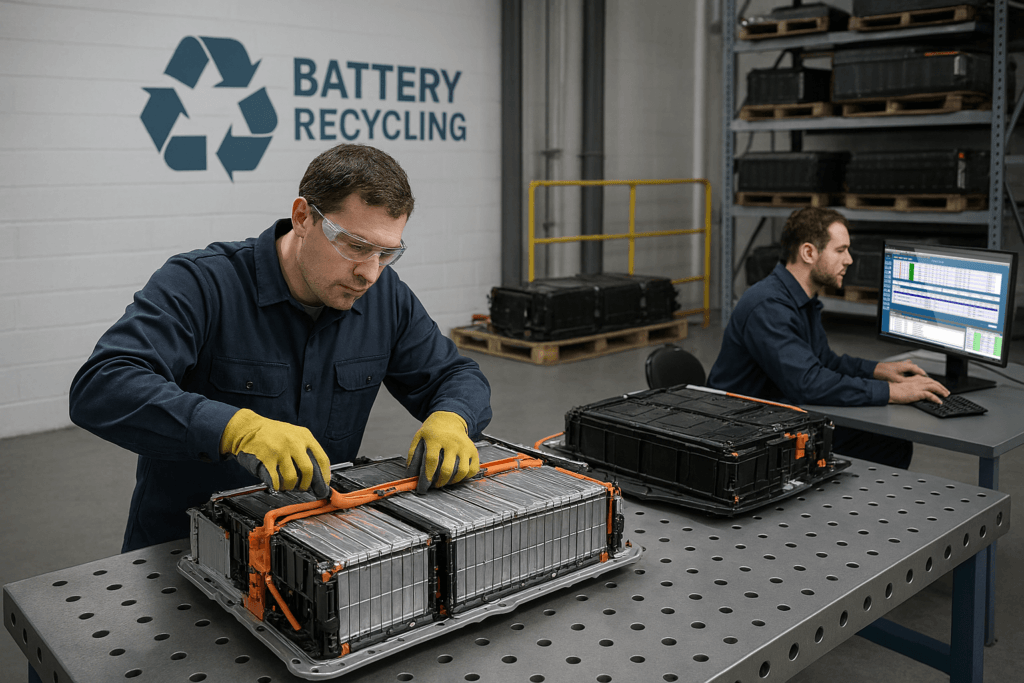

Testing & Recycling EV Batteries: How the Process Works and How A&D Supports Every Step
As electric vehicles continue to expand across global markets, the question of what happens to EV batteries at the end of their first life has become increasingly important. Automakers, Tier 1 suppliers, and independent test houses are all searching for ways to determine whether a battery should be recycled, remanufactured, or reused—and rigorous testing is at the center of that decision.
Below is a guide explaining how EV batteries are tested, how recyclability or reusability is determined, and where A&D Technology’s test solutions play a crucial role across the full battery lifecycle.
Q&A: EV Battery Testing, Recycling, and Reuse
Q: How are EV batteries tested to determine if they should be recycled or reused?
Before an EV battery pack, module, or cell enters the recycling stream, it undergoes a structured evaluation of:
- State of Health (SOH)
- Remaining capacity
- Internal resistance
- Safety and thermal stability
- Performance under controlled load
- Voltage consistency across cells
These tests help identify whether the battery can:
- Return to a vehicle after repair or remanufacturing,
- Enter a second‑life application such as stationary storage, or
- Move directly to recycling if it no longer meets performance or safety criteria.
A&D’s battery test systems—powered by iTest, iTest.BTS Battery Test Automation, Battery HILS Simulation Systems, and LabWorX Lab Management Systems automate these evaluations with repeatable, data‑rich workflows used by OEMs, battery manufacturers, and remanufacturers.
Q: What types of tests are used when evaluating used EV batteries?
Common tests include:
1. Capacity Test
Measures how much energy the battery can still hold versus its rated capacity.
2. DC Internal Resistance (DCIR)
Tracks how much resistance has increased over time; high resistance suggests aging or damage.
3. Charge/Discharge Cycling
Performed under controlled conditions to measure degradation behavior.
4. Open Circuit Voltage (OCV) Testing
Analyzes cell or module voltage spread to identify imbalances or failures.
5. Thermal Characterization
Checks for abnormal heat signatures or thermal runaway risks.
6. Electrical Safety Testing
Includes insulation resistance, short‑circuit behavior, grounding integrity, and safety interlock validation.
A&D solutions for controlling high‑power cycling and pack‑level simulation—automate these tests with high‑resolution data capture.
Q: What qualifies a battery as suitable for renewal or reuse?
While criteria vary by OEM, second‑life provider, and chemistry type, common thresholds include:
- SOH greater than 70–80%
for automotive reuse - SOH greater than 50–70%
for second‑life stationary energy storage - Limited cell imbalance
meaning voltage spread across the pack stays within acceptable margins - Normal thermal behavior
no hotspots or rapid temperature increases under load - Stable resistance growth
indicating predictable aging rather than sudden failure modes - Passage of safety checks
(continuous insulation monitoring, no hazardous conditions, etc.)
A&D’s test control software and lab management software calculate SOH and generate standardized reports to document reuse eligibility.
Q: What kind of data is collected during EV battery testing?
Battery diagnostic workflows typically capture:
- Voltage, current, and temperature (VIT) data at high sampling rates
- Charge/discharge efficiency
- Energy throughput
- Resistance mapping
- Coulombic efficiency
- Cycle count history
- Thermal response curves
- Degradation models and trend predictions
- Pack balancing performance
This data helps remanufacturers determine the battery’s safest and most economical next life cycle.
Q: Does battery testing vary based on chemistry or design?
Yes. Testing parameters vary depending on:
- Chemistries: Common Lithium‑Ion Battery Chemistries Include:
- NMC — Lithium Nickel Manganese Cobalt Oxide
- Formula: Li(NiMnCo)O₂
- Strengths: High energy density, good cycle life, balanced power/energy characteristics
- Applications: EV traction batteries (very common), hybrid systems
- Testing Context: Often used in high‑voltage pack test stands with thermal characterization and cycle‑life automation
- LFP — Lithium Iron Phosphate
- Formula: LiFePO₄
- Strengths: Excellent thermal stability, long cycle life, high safety, lower cost
- Tradeoffs: Lower energy density than NMC or NCA
- Applications: Commercial vehicles, stationary storage, cost‑optimized EVs
- Testing Context: Common in durability test cells and pack validation, especially where thermal runaway resistance is key.
- NCA — Lithium Nickel Cobalt Aluminum Oxide
- Formula: Li(NiCoAl)O₂
- Strengths: Very high energy density and power capability
- Tradeoffs: Lower thermal stability than LFP, expensive due to cobalt
- Applications: High‑performance EVs and aerospace battery systems
- Testing Context: Often paired with HIL simulation to evaluate safety controls and fast‑charge behavior.
- LMO — Lithium Manganese Oxide
- Formula: LiMn₂O₄
- Strengths: High thermal stability, good power delivery, relatively low cost
- Tradeoffs: Lower cycle life compared to NMC or LFP
- Applications: Power tools, some HEVs, blended‑chemistry packs (LMO + NMC)
- Testing Context: Ideal for power‑cycle and pulse testing; A&D dynamometer‑based systems often use LMO for hybrid architectures during development.
- NMC — Lithium Nickel Manganese Cobalt Oxide
- Format: pouch, cylindrical, prismatic
- Scale: cell, module, pack
- Cooling type: air‑cooled, liquid‑cooled, refrigerant‑cooled
- Intended second life: grid storage, microgrid, UPS, EV reuse
Q: How are EV batteries recycled?
EV battery recycling typically follows these steps:
1. Safe discharge and disassembly
Modules and cells are deactivated and opened in controlled environments.
2. Material separation
Depending on the recycler, methods may include:
- Pyrometallurgy: high‑temperature smelting
- Hydrometallurgy: chemical leaching to extract metals
- Mechanical processing: shredding and material separation
3. Recovery of critical materials
Nickel, cobalt, manganese, lithium, graphite, copper, and aluminum are reclaimed for reuse.
4. Reintegration into the battery supply chain
Recovered materials re‑enter cathode/anode production.
Q: How does EV battery recycling impact the environment?
Recycling significantly reduces:
- The need for new mining of lithium, cobalt, and nickel
- CO₂ emissions associated with raw material extraction
- Energy consumption across the battery supply chain
- Waste by diverting batteries from landfills
- Transportation miles when recycling is done close to the point of collection
However, recycling done without proper safety and emissions controls can increase energy usage and create chemical waste. This is why accurate testing, battery grading, and safe disassembly are essential before any recycling process begins.
How A&D Technology Supports Battery Lifecycle Testing—from R&D to Recycling
A&D Technology helps organizations across the EV battery value chain:
R&D and Production Testing
- Automation and control of battery test equipment with iTest.BTS
- Lab orchestration and data management through LabWorX
- BMS validation using Battery HILS
Field Return & Remanufacturing
- SOH evaluation systems for pack, module, and cell levels
- Safety monitoring alarm triggers
- Flexible test architecture for teardown and grading workflows
Recycling Support
- Pre‑recycling control of discharge tests
- Data‑driven grading to determine reuse vs. recycle
- Integration with automated disassembly environments
Whether you’re an OEM, Tier 1 supplier, independent test lab, or battery remanufacturer, A&D provides test systems that can integrate with 3rd party battery test equipment, custom software development, engineering support, installation, commissioning, and ongoing service plans.
Contact A&D to start planning your battery recycling testing solutions