
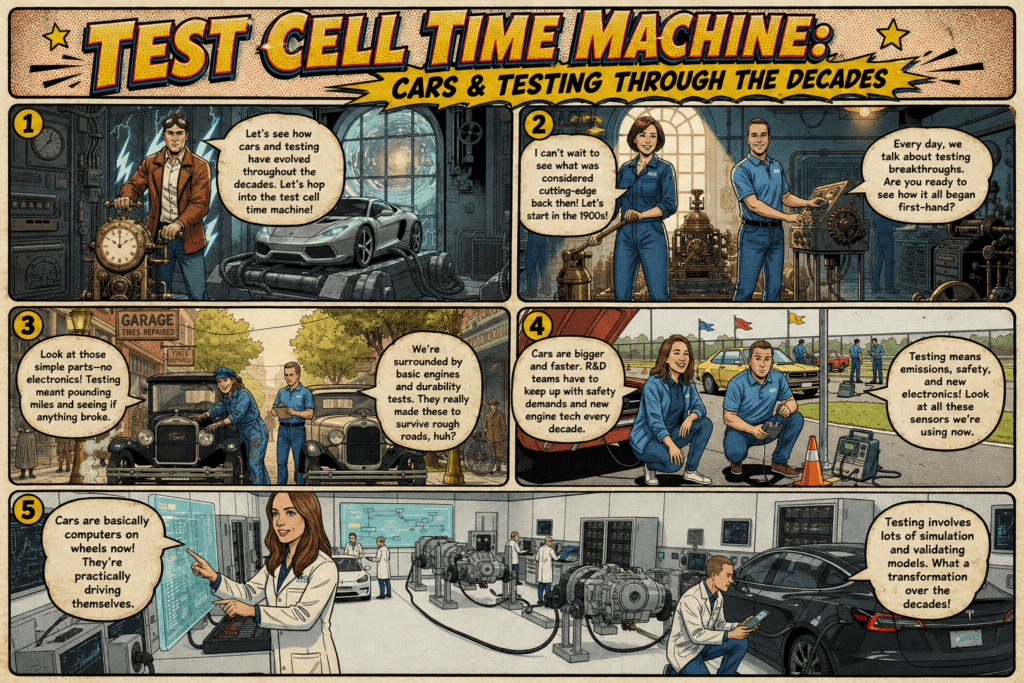
From the earliest days of mass production to today’s software-defined electric vehicles, the automotive industry has been shaped by a series of iconic cars that defined each generation. Each decade brought new innovations—not just in design and performance, but in how engineers approach testing, validation, and development.
For test engineers, this evolution tells an important story: as vehicles became more complex, the tools and processes required to validate them had to evolve just as quickly.
A Decade-by-Decade Look at Influential Vehicles
Here’s a simplified timeline of standout vehicles that highlight major shifts in automotive engineering:
-
1900s–1910s: Ford Model T
The foundation of modern automotive manufacturing. Its mass production introduced repeatable testing processes for durability and performance. -
1920s: Ford Model A
Increased focus on driver experience and refinement, requiring more structured validation of comfort and drivability. -
1930s: Chrysler Airflow / Volkswagen Beetle (prototype)
Early aerodynamics and efficiency concepts began shaping vehicle testing requirements, especially for airflow and drag. -
1940s: Willys Jeep
Rugged, military-grade durability testing became critical—introducing extreme condition validation methodologies. -
1950s: Chevrolet Bel Air
High-power V8 engines and styling advancements drove the need for improved engine performance testing and chassis development. -
1960s: Ford Mustang
The rise of performance vehicles accelerated testing around horsepower, torque delivery, and drivetrain durability. -
1970s: Honda Civic
Fuel efficiency and emissions became priorities, introducing regulatory-driven testing and tighter validation standards. -
1980s: Toyota Corolla
Reliability and quality control took center stage, emphasizing long-term endurance testing and manufacturing consistency. -
1990s: Toyota Camry / Honda Accord
Global platforms required standardized testing strategies across regions, increasing the need for centralized data management. -
2000s: Toyota Prius
Hybrid systems introduced new challenges in battery testing, electric motor validation, and powertrain integration. -
2010s: Tesla Model S
Fully electric vehicles shifted focus toward battery performance, thermal management, and software validation. -
2020s: Tesla Model 3 / Model Y
Software-defined vehicles and EV scalability have made system integration, real-time simulation, and data-driven validation essential.
How Vehicle Evolution Transformed Test Engineering
As automotive technology advanced, so did the complexity of validation:
- Mechanical systems evolved into electromechanical and software-driven architectures
- Powertrains shifted from internal combustion engines to electrified systems
- Testing expanded from component-level validation to full system integration
Today’s engineers must validate:
- Electric motors and battery systems
- Advanced driver assistance systems (ADAS)
- Vehicle control software and embedded systems
- Integrated powertrain performance across multiple operating modes
This requires highly integrated test environments that combine automation, control, data acquisition, simulation, and enterprise-level data management.
Enabling Next-Generation Vehicle Testing with A&D Technology
At A&D Technology, we support test engineers across OEMs, Tier 1 suppliers, and research institutions with scalable solutions designed for modern mobility challenges.
Integrated Test & Validation Solutions
These systems enable seamless testing across:
- Engines and hybrid systems
- Electric motors and inverters
- Battery packs and energy storage systems
- Complete vehicle powertrains
Engineering Services That Extend Your Team
Beyond technology, A&D provides:
- Consulting and custom software development
- Full project management and system integration
- Equipment procurement and installation
- Training, support, and resident engineering services
This ensures your team can move from concept to validation faster—without compromising accuracy or safety.
Looking Ahead: The Future of Validation
As vehicles continue to evolve, the role of test engineering will only grow in importance. Electrification, autonomy, and connected vehicle ecosystems demand:
- Faster test cycles
- Higher data fidelity
- Greater system-level visibility
The next generation of innovation will depend not just on vehicle design—but on how effectively those designs are validated.