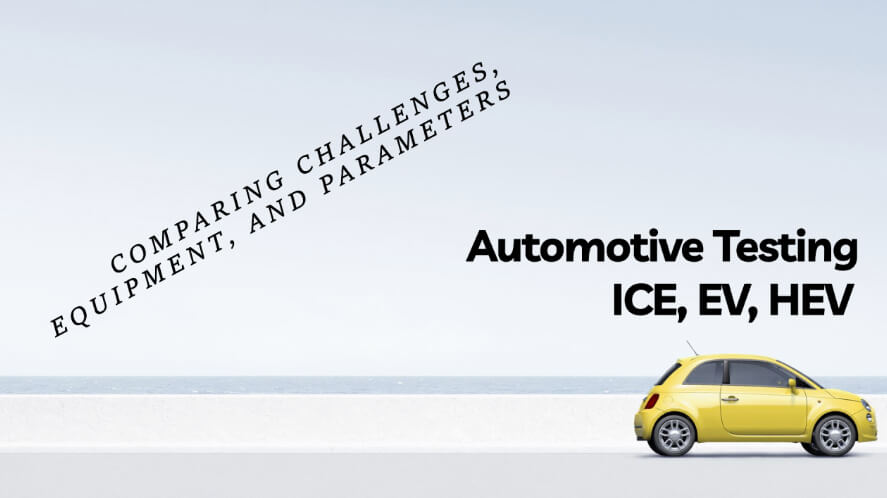
The automotive industry is hard at work testing and developing different types of vehicles including: hybrid (HEVs), internal combustion engine (ICE), and electric vehicles (EVs). Each type of vehicle presents unique challenges and requires specific testing equipment and parameters during the research and development (R&D) phase. Let’s delve into some of the differences and intricacies of testing these three vehicle types.
Hybrid Vehicles (HEVs)
Challenges:
-
Complex Powertrain Systems: HEVs combine both electric motors and ICE, which requires intricate testing to ensure seamless integration and operation.
-
Battery Life and Performance: The battery system in HEVs must be rigorously tested for durability, charge retention, and performance under various conditions.
-
Regenerative Braking: Testing the efficiency and reliability of regenerative braking systems is crucial as it contributes significantly to the vehicle’s overall efficiency.
Testing Equipment:
-
Battery Cyclers: To test the endurance and charge cycles of hybrid batteries.
-
Dynamometers: For simulating driving conditions and measuring the power output of the electric motor and ICE.
-
Thermal Imaging Cameras: To monitor the temperature profiles of batteries and electric components during operation.
Testing Parameters:
-
Fuel Efficiency: How effectively the vehicle utilizes fuel, especially during transitions between electric and ICE modes.
-
Emissions: Measurement of pollutants emitted when the ICE is in operation.
-
Electric Range: The distance the vehicle can travel on electric power alone before the ICE needs to engage.
Internal Combustion Engine Vehicles (ICE)
Challenges:
-
Emission Regulations: Stricter emission standards require ICE vehicles to be cleaner and more efficient than ever before.
-
Fuel Consumption: With rising fuel prices, ICE vehicles need to maximize fuel economy without compromising performance.
-
Engine Performance: Ensuring that the engine delivers the expected power and torque across various operating conditions.
Testing Equipment:
-
Emission Analyzers: To measure the concentration of various gases like CO2, NOx, and particulate matter.
-
Chassis Dynamometers: For assessing vehicle performance, including acceleration, fuel consumption, and emissions under controlled conditions.
-
Pressure Sensors: To monitor the combustion process within the engine cylinders.
Testing Parameters:
-
Horsepower and Torque: The power output of the engine.
-
Miles Per Gallon (MPG): The distance the vehicle can travel per gallon of fuel.
-
Exhaust Gas Composition: The chemical makeup of the vehicle’s exhaust, which is critical for meeting emission standards.
Electric Vehicles (EVs)
Challenges:
-
Battery Technology: EVs rely entirely on their battery packs, which must be tested for long-term reliability and safety.
-
Charging Infrastructure: Ensuring compatibility with various charging stations and testing the speed and efficiency of charging.
-
Thermal Management: Batteries and electric motors generate heat, which must be managed effectively to prevent performance degradation.
Testing Equipment:
-
Battery Test Systems: For evaluating battery capacity, discharge rates, and longevity.
-
Electric Motor Testers: To measure the performance and efficiency of the motor.
-
Environmental Chambers: To simulate extreme temperatures and conditions to test vehicle components’ durability.
Testing Parameters:
-
Range: The total distance an EV can travel on a full charge.
-
Charging Time: How quickly the vehicle’s battery can be charged from empty to full.
-
Energy Consumption: The amount of electrical energy used to travel a certain distance.
This shift towards more sustainable automotive technologies has brought about new challenges and necessitated the development of specialized testing protocols. As the industry continues to innovate, the R&D testing landscape for HEVs, ICE vehicles, and EVs will evolve, ensuring that the vehicles of tomorrow are not only environmentally friendly but also safe, reliable, and efficient.