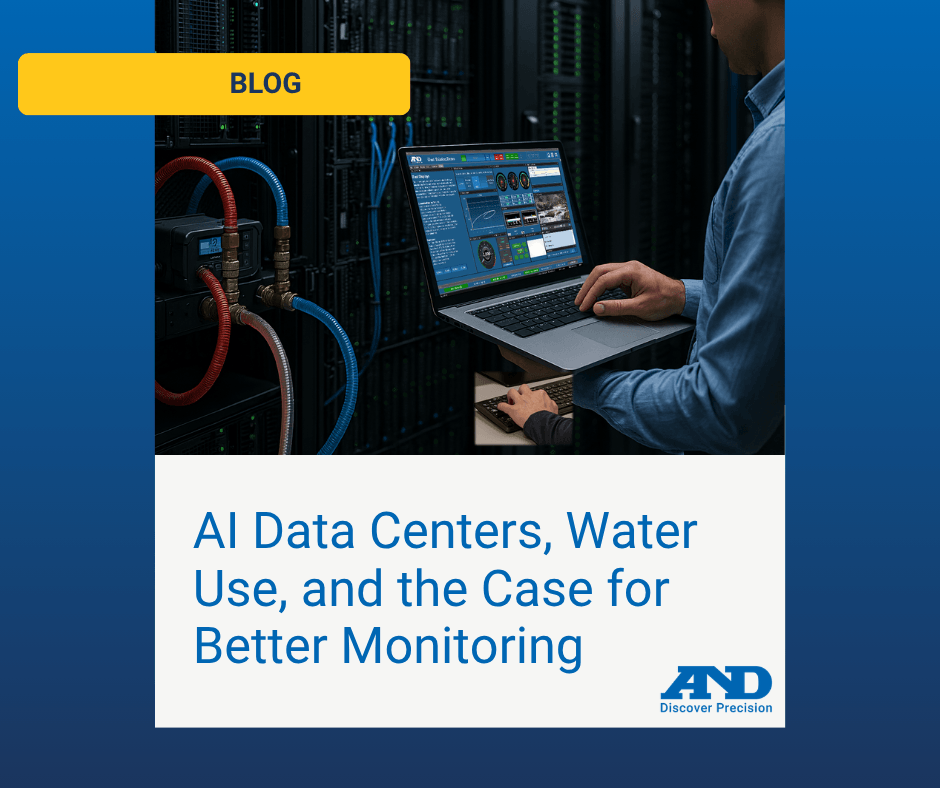

AI Data Centers, Water Use, and the Case for Better Monitoring
Why Water Is the Next Battleground for AI Data Centers
AI data centers are no longer judged solely by compute power or energy efficiency. In 2026, water usage has become one of the most closely scrutinized aspects of data center design and operation.
As artificial intelligence workloads grow, so does the heat generated by high‑density servers and accelerators. Keeping those systems within safe operating temperatures requires sophisticated cooling strategies—many of which rely heavily on water. For communities, investors, and regulators, the question is no longer whether AI data centers use water, but how much, when, and how efficiently.
This has elevated water monitoring, cooling validation, and transparent data into critical requirements for modern AI data centers.
How AI Data Centers Use Water Today
Traditional Water‑Based Cooling Explained
Most large AI data centers today use some variation of water‑assisted air cooling, often through cooling towers and evaporative systems.
Here’s how it works:
- Heat Removal from Servers
Heat generated by servers is transferred to air or water loops via heat exchangers. - Evaporative Cooling
Warm water is sent to cooling towers, where a portion evaporates to remove heat. - Make‑Up Water Demand
Evaporated water must be replaced—often with potable municipal water. - Peak Demand Spikes
On hot days, water withdrawal can spike dramatically, stressing local infrastructure.
A single hyperscale AI data center can withdraw over one million gallons of water per day, with demand peaking during heat waves—the exact moments when communities are already water‑constrained.
This is why accurate, high‑resolution water monitoring is essential. Without it, operators and municipalities are effectively blind to when and why consumption surges occur.
Liquid Cooling and Immersion Cooling: Why They Use Less Water
Liquid Cooling
In liquid‑cooled data centers:
- Coolant (typically water or dielectric fluid) is circulated directly to cold plates on CPUs and GPUs
- Heat is removed more efficiently than with air
- Less heat needs to be rejected through evaporative cooling
Water savings: Up to 50–80% compared to traditional evaporative systems.
Immersion Cooling
Immersion cooling takes this further:
- Servers are submerged in a non‑conductive dielectric fluid
- Heat is transferred directly from components into the fluid
- Minimal or no evaporative cooling is required
Water savings: Up to 95% reduction in water use.
Why Isn’t Liquid or Immersion Cooling Everywhere Yet?
If liquid and immersion cooling are so water‑efficient, why aren’t all AI data centers using them?
The answer is complexity, cost, and validation risk.
Key barriers include:
- Upfront capital costs for new cooling infrastructure
- Retrofitting challenges in existing data centers
- Operational risk if cooling systems are not properly validated
- Lack of standardized test data across vendors and designs
- Uncertainty around long‑term reliability and maintenance
This is where cooling validation and test engineering become critical. Before operators commit to new cooling architectures, they must prove—under real‑world conditions—that systems perform reliably, efficiently, and safely at scale.
Graywater and Wastewater Reuse: Reducing Community Impact
Another major trend in AI data center water management is the use of graywater and reclaimed wastewater.
How It Works
- Municipal or industrial wastewater is treated to a non‑potable standard
- Reclaimed water is used for cooling towers instead of drinking water
- Potable water demand is reduced, easing community concerns
Challenges
- Water quality varies and must be continuously monitored
- Scaling, corrosion, and biofouling risks increase
- Systems require robust testing, instrumentation, and data oversight
Using reclaimed water effectively depends on accurate sensing, monitoring, and control—not just plumbing changes.
Where A&D Technology Fits: From Cooling Validation to Water Monitoring
A&D Technology supports AI data centers by enabling data‑driven cooling and water management decisions—from R&D through operation.
Cooling System Test & Validation, Water, and Thermal Monitoring
Using our systems for test control, automation, simulation, and lab management, A&D Technology helps engineers:
- Validate liquid and immersion cooling performance
- Instrument thermal, flow, pressure, and power systems
- Stress‑test cooling loops under peak AI workloads
- Compare cooling architectures with defensible data
- Capture synchronized water flow, temperature, and energy data
- Track water usage effectiveness (WUE) trends
- Support regulatory, investor, and community reporting
- Feed high‑quality data into AI‑based optimization tools
In short, better data enables better water stewardship.
What Communities Gain from AI Data Centers
Despite concerns, AI data centers can deliver real local benefits when properly planned.
Job Creation
Data centers create fewer jobs than factories, but they are:
- High‑skill, high‑wage roles
- Long‑term and stable
Typical roles include:
- Electrical and mechanical technicians
- Controls and instrumentation specialists
- IT and network engineers
- Facilities and reliability engineers
- Construction and commissioning contractors
Economic and Infrastructure Benefits
- Increased local tax base
- Infrastructure upgrades (power, fiber, water systems)
- Demand for local engineering, construction, and maintenance services
- Potential partnerships with universities and trade schools
Transparent water monitoring and responsible cooling strategies are key to maintaining community trust and unlocking these benefits.
The Bottom Line
AI data centers are here to stay—but the era of unchecked water use is over.
The path forward isn’t just new cooling hardware. It’s validated designs, continuous monitoring, and trustworthy data that prove efficiency claims in real‑world conditions.
That’s where A&D Technology helps AI data centers move from promises to proof.