
As the automotive industry rapidly diversifies, R&D organizations are no longer developing one type of powertrain. Today’s test engineers are often asked to support internal combustion engines (ICE), hybrid electric vehicles (HEVs), battery electric vehicles (BEVs)—and increasingly, fuel cell electric vehicles (FCEVs)—all within the same lab environment.
Each propulsion architecture works differently. Each requires different validation strategies. And each introduces new complexity to test systems, data management, and automation.
So how does automotive R&D testing differ across vehicle types—and how can a single, streamlined test ecosystem support them all?
Let’s break it down.
Powertrain Types:
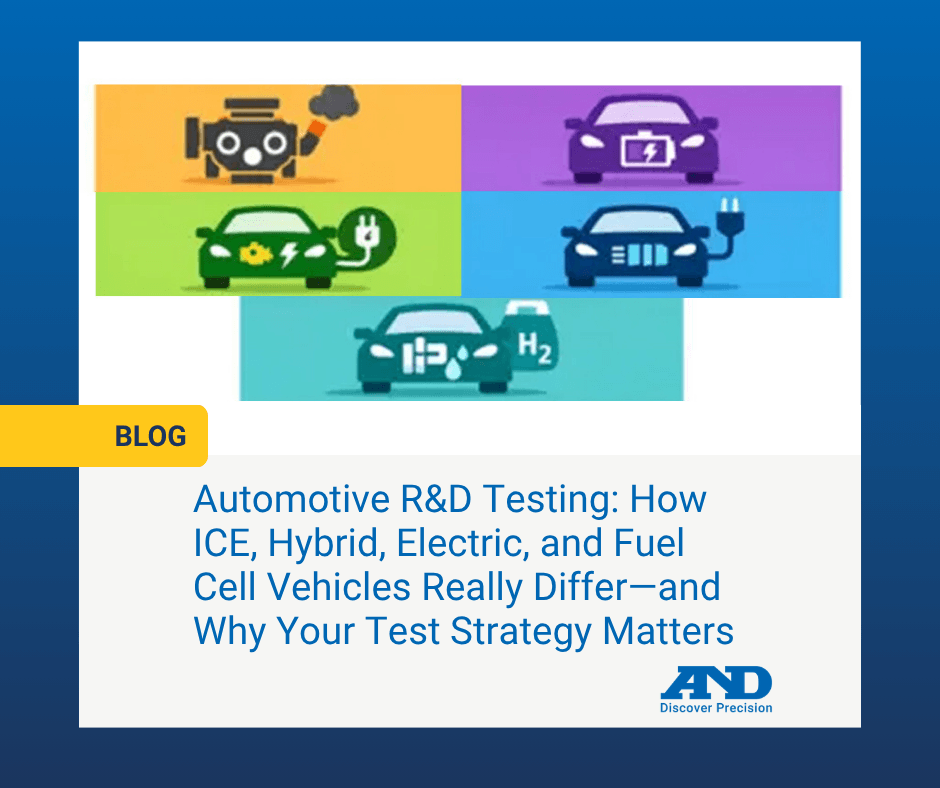
Before diving in, it’s worth clarifying the major categories seen in modern automotive R&D:
- ICE (Internal Combustion Engine) vehicles
- Hybrid vehicles (mild hybrid, full hybrid, plug-in hybrid)
- Battery Electric Vehicles (BEVs)
- Fuel Cell Electric Vehicles (FCEVs)
While ICE, hybrid, and electric vehicles dominate today’s development pipelines, fuel cell systems are becoming increasingly relevant in both passenger and heavy-duty applications—and they bring their own unique testing needs.
ICE Vehicles: Engine-Centric Testing Still Sets the Foundation
How ICE Vehicles Work
ICE vehicles rely on combustion of fuel within an engine to produce mechanical torque, which is transmitted through the drivetrain to the wheels. Despite electrification trends, ICE platforms remain critical—especially in hybrid architectures and global markets.
How ICE Testing Works
R&D testing for ICE vehicles focuses on engine performance, durability, emissions, and calibration, typically using:
- Engine dynamometers for torque, speed, and power measurement
- Transient and steady-state test cycles
- Combustion analysis and emissions measurement
- Thermal management and endurance testing
Key Testing Challenges
- Increasing regulatory complexity
- Higher channel counts and faster data rates
- Integration of aftertreatment and hybrid components
A&D Technology Advantage:
A&D’s iTest® automation and control software and our Phoenix combustion analysis systems are widely used for advanced engine testing, providing precise control, synchronized data, and scalable automation across single-cylinder to full-engine test stands.
A&D’s iTest® automation and control software and our Phoenix combustion analysis systems are widely used for advanced engine testing, providing precise control, synchronized data, and scalable automation across single-cylinder to full-engine test stands.
Hybrid Vehicles: Where Engine and Motor Testing Converge
How Hybrid Vehicles Work
Hybrid vehicles combine an ICE with one or more electric motors and an energy storage system. Power can come from the engine, the motor, or both—depending on operating conditions.
How Hybrid Testing Works
Hybrid R&D testing is inherently more complex because it must validate interactions between systems, not just individual components:
- Engine + motor coordination
- Power split and energy management strategies
- Regenerative braking performance
- Drive cycle simulation
Testing often requires multi-dyno setups, real-time simulation, and hardware-in-the-loop (HIL) environments.
Key Testing Challenges
- Synchronizing multiple control domains
- Managing hybrid-specific transient events
- Validating system-level efficiency and durability
A&D Technology Advantage:
A&D’s Helios and Battery HILS platforms enable real-time simulation of engines, motors, and batteries—while iTest and LabWorX™ manage complex workflows, automation, lab processes, and data across hybrid test cells. Hybrid engineers benefit from a single test ecosystem rather than disconnected tools.
A&D’s Helios and Battery HILS platforms enable real-time simulation of engines, motors, and batteries—while iTest and LabWorX™ manage complex workflows, automation, lab processes, and data across hybrid test cells. Hybrid engineers benefit from a single test ecosystem rather than disconnected tools.
Electric Vehicles: Motor and Battery Take Center Stage
How Electric Vehicles Work
Battery electric vehicles eliminate the engine entirely. Energy stored in a battery pack powers one or more electric motors via power electronics.
How EV Testing Works
EV testing shifts the focus from combustion to electrical, thermal, and system efficiency performance, including:
- Electric motor and inverter testing
- Battery performance, safety, and aging
- Thermal runaway and abuse testing
- Efficiency mapping and NVH analysis
Motor and battery testing often occur on separate stands but must be correlated at the vehicle level.
Key Testing Challenges
- High-voltage safety requirements
- Thermal management complexity
- Massive data volumes from long-duration tests
A&D Technology Advantage:
A&D supports EV development with integrated battery and motor testing solutions such as iTest.BTS, Battery HILS, Motor HILS, and Thermal Emulator, enabling safe, automated, and repeatable testing from cell to system level.
A&D supports EV development with integrated battery and motor testing solutions such as iTest.BTS, Battery HILS, Motor HILS, and Thermal Emulator, enabling safe, automated, and repeatable testing from cell to system level.
Fuel Cell Vehicles: A Growing R&D Frontier
How Fuel Cell Vehicles Work
FCEVs generate electricity onboard using hydrogen fuel cells, combining aspects of EVs and energy systems testing.
How Fuel Cell Testing Works
Testing focuses on:
- Fuel cell stack performance
- Balance-of-plant components
- Durability and degradation
- System efficiency under transient loads
These tests demand tight integration of electrical, thermal, and fluid control systems.
A&D Technology Advantage:
A&D’s custom hardware, real-time control, and lab automation and management platforms allow engineers to adapt existing EV and energy storage test infrastructure to emerging fuel cell applications.
A&D’s custom hardware, real-time control, and lab automation and management platforms allow engineers to adapt existing EV and energy storage test infrastructure to emerging fuel cell applications.
One Test Partner for Every Powertrain
The biggest challenge facing automotive R&D today isn’t which powertrain to test—it’s how to support all of them efficiently.
A&D Technology specializes in integrated, flexible test solutions that scale across:
- Engines, motors, batteries, and full powertrains
- ICE, hybrid, EV, and fuel cell architectures
- Component, subsystem, and system-level testing
With flexible, integrated test systems, A&D helps organizations avoid siloed test systems and instead build a unified, future-ready test environment no matter what or how they’re testing.
From consulting, engineering studies, project management and custom software development to installation, training, and resident engineers, A&D Technology partners with OEMs, Tier 1 suppliers, universities, and independent test houses to accelerate development—no matter where the industry goes next.