
In the highly regulated world of automotive testing and mobility R&D, consistency, traceability, and quality are non-negotiable. That’s where ISO standards come in.
For companies like A&D Technology, achieving and maintaining ISO 9001:2015 certification is more than a checkbox—it’s a commitment to delivering reliable, high-quality testing systems that engineers trust every day.
What Are ISO Standards?
ISO standards are internationally recognized frameworks developed to ensure quality, safety, efficiency, and interoperability across industries.
- ISO stands for the International Organization for Standardization
- Founded in 1947, ISO is an independent, non-governmental organization
- It brings together experts from over 160 countries to develop consensus-based standards
These standards provide a common language and set of expectations across global supply chains—critical in industries like automotive where collaboration is essential.
Why ISO Standards Matter in Automotive Testing
Automotive engineering—especially in powertrain, electrification, and emissions testing—relies heavily on repeatability and data integrity. ISO standards help ensure:
- Consistent test processes
- Reliable and traceable data
- Improved product quality
- Reduced risk and rework
- Global supplier alignment
For test environments using dynamometers, Hardware-in-the-Loop (HiL), and advanced automation systems (like A&D’s iTest, LabWorX, and HILS platforms), standardized processes are essential to maintaining confidence in results.
Key ISO Standards Relevant to the Automotive Testing Industry
Here are some of the most important ISO standards that apply to automotive, testing, and manufacturing:
Quality Management
- ISO 9001:2015 – Quality Management Systems (QMS)
- Focuses on consistent delivery, customer satisfaction, and continuous improvement
- IATF 16949 – Automotive-specific QMS (built on ISO 9001)
- Widely required for automotive OEM and supplier certification
Testing and Calibration
- ISO/IEC 17025 – Testing and calibration laboratory competence
- Critical for labs performing emissions, durability, and component validation testing
Functional Safety & Systems
- ISO 26262 – Functional safety for automotive systems
- Essential for electronics, ECUs, and electric powertrain safety validation
Environmental & Energy
These standards collectively support the full lifecycle of vehicle development—from component validation to system-level testing.
Spotlight: A&D Technology’s ISO 9001:2015 Certification
A&D Technology is proud to be ISO 9001:2015 certified, demonstrating a strong commitment to quality in every solution we deliver—from dynamometer automation to custom software and integrated test systems.
You can view our certification here:
https://aanddtech.com/about-adt/iso-certificate/
https://aanddtech.com/about-adt/iso-certificate/
What ISO 9001:2015 Means in Practice
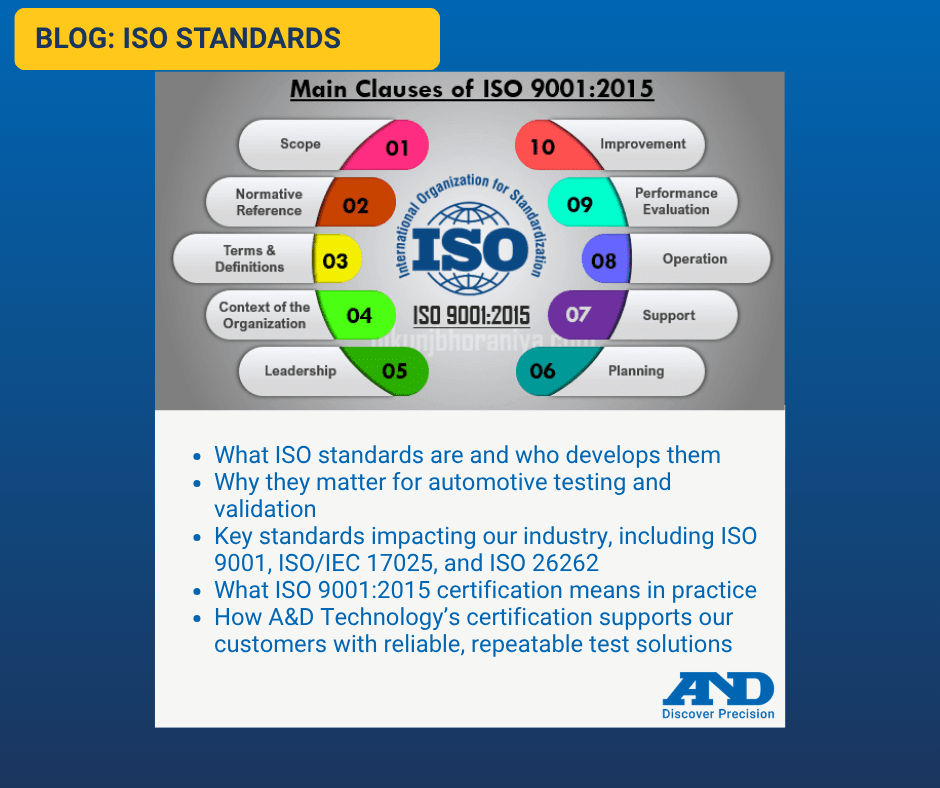
ISO 9001:2015 is built around a process-driven quality management system and includes:
- Customer focus and satisfaction
- Risk-based thinking
- Documented processes and procedures
- Continuous improvement initiatives
- Leadership engagement and accountability
For A&D, this translates into delivering robust, validated solutions across platforms like:
- iTest (test cell control and automation)
- LabWorX (data management and workflow automation)
- Helios HILS (real-time simulation environments)
Our ISO certification ensures these systems are developed, integrated, and supported with consistent quality.
Why ISO Certification Matters to Our Customers
For OEMs, Tier 1 suppliers, and research labs, working with ISO-certified partners reduces risk and ensures alignment.
Benefits to Customers:
- Confidence in repeatable, high-quality test systems
- Assurance of documented processes and traceability
- Simplified supplier qualification and audits
- Reduced project risk in complex test environments
In many cases, customers require suppliers to be ISO certified as a prerequisite for doing business—particularly for critical testing equipment and software in regulated environments.
ISO 9001 Certification Requirements (High-Level)
To achieve ISO 9001:2015 certification, organizations must demonstrate:
- Defined Quality Management System (QMS)
- Clear process documentation and controls
- Risk identification and mitigation strategies
- Internal audits and corrective actions
- Customer feedback and satisfaction tracking
- Continuous improvement processes
- Leadership accountability and engagement
Certification is awarded by accredited third-party auditors after a comprehensive review.
How Often Are Companies Evaluated?
ISO certification is not a one-time achievement—it requires continuous verification.
- Full recertification audit: Every 3 years
- Surveillance audits: Annually (or semi-annually depending on scope)
This ongoing evaluation ensures companies like A&D maintain consistent adherence to quality standards.
The Bigger Picture: ISO as a Competitive Advantage
In today’s rapidly evolving mobility landscape—electrification, autonomy, hybrid systems—test complexity is increasing. ISO standards provide the framework needed to scale innovation without compromising quality.
At A&D Technology, ISO 9001:2015 certification reinforces our mission:
To deliver integrated, reliable, and scalable test solutions that help engineers move faster with confidence.