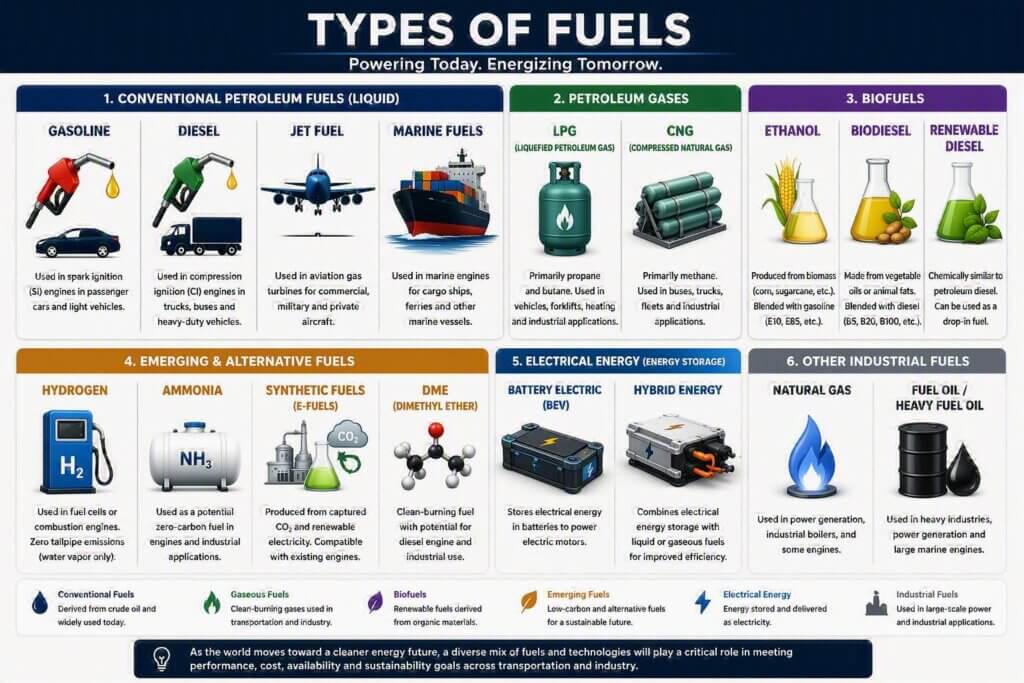

As the mobility industry transitions toward decarbonization, test engineers are now working across a broader spectrum of fuels and energy systems. From conventional petroleum fuels to gaseous fuels, biofuels, and emerging options like hydrogen and synthetic fuels, each introduces unique combustion behaviors, infrastructure needs, and validation challenges.
This guide expands on fuel fundamentals—what distinguishes them, how they’re produced, how they perform—and, critically, how testing methodologies evolve with each fuel type.
1. Combustion Fundamentals: Spark Ignition vs. Compression Ignition
Understanding combustion is foundational to fuel differences.
Spark Ignition (SI)
Used in: Gasoline engines, some LPG (Liquefied Petroleum Gas) and CNG (Compressed Natural Gas) engines
How it works:
- Air and fuel are mixed before entering the cylinder
- A spark plug ignites the mixture at a precise timing point
- Combustion propagates as a flame front across the chamber
Key characteristics:
- Requires fuels with high octane rating (resistance to knock)
- Smooth and controlled combustion
- Typically used in light-duty vehicles
Compression Ignition (CI)
Used in: Diesel engines, heavy-duty applications, some biofuel blends
How it works:
- Air is compressed to a very high pressure and temperature
- Fuel is injected directly into hot compressed air
- The mixture auto-ignites without a spark plug
Key characteristics:
- Requires fuels with high cetane rating (ease of ignition)
- Higher thermal efficiency than SI
- More torque output, widely used in heavy-duty and industrial systems
2. Conventional Fuels Explained
Gasoline
Application: Passenger vehicles (SI engines)
Refining characteristics:
- Light fraction of crude oil distillation
- Blended with additives to improve octane and emissions
Performance:
- Fast-burning fuel
- Lower energy density than diesel
- Optimized for high-speed performance
Diesel
Application: Trucks, agricultural, construction, marine engines (CI)
Refining characteristics:
- Heavier fraction than gasoline
- Higher energy density
Performance:
- Slower burn, higher torque
- Greater fuel efficiency
- Produces particulates and NOx (requires aftertreatment systems)
Jet Fuel (e.g., Jet-A, JP-8)
Application: Aviation turbines
Properties:
- Narrow boiling range for consistent combustion
- High energy density
- Must perform under extreme temperature conditions
Performance considerations:
- Stability at altitude
- Resistance to freezing
- Clean combustion critical for turbine longevity
Marine Fuels
Application: Cargo ships, marine engines
Types:
- Marine diesel
- Heavy fuel oil (HFO)
Characteristics:
- Often lower-grade, higher sulfur (regulated under IMO standards)
- High viscosity fuels require heating before injection
Performance:
- Optimized for long-duration, steady-state operation
- Increasing shift toward cleaner marine fuels and LNG
3. Petroleum Gases: LPG & CNG
Liquefied Petroleum Gas (LPG)
Composition: Propane, butane
Storage: Liquefied under moderate pressure
Common uses:
- Fleet vehicles (taxis, buses)
- Industrial forklifts
- Residential heating and cooking
Advantages:
- Lower CO₂ emissions than gasoline
- Clean-burning with reduced particulates
Compressed Natural Gas (CNG)
Composition: Primarily methane
Storage: High-pressure gas cylinders
Common uses:
- Public transit fleets
- Long-haul trucking
- Municipal and utility vehicles
Advantages:
- Lower emissions (CO₂, NOx)
- Lower fuel cost in many regions
Considerations for both LPG/CNG:
- Reduced energy density → shorter range
- Requires specialized fuel systems and storage infrastructure
4. Biofuels: Renewable Energy Sources
Ethanol
- Produced via fermentation (corn, sugarcane)
- Common blends: E10, E85
- High octane → suitable for SI engines
- Lower energy density than gasoline
Biodiesel
- Derived from vegetable oils and fats (transesterification)
- Used in CI engines (B5–B100)
- Improves lubricity but may impact cold-start performance
Renewable Diesel
- Chemically similar to petroleum diesel
- Drop-in replacement without engine modification
- Increasing adoption for fleet decarbonization
Key benefits:
- Reduced lifecycle CO₂ emissions
- Compatibility with existing infrastructure (depending on type)
5. Emerging and Future Fuels
Hydrogen
- Used in fuel cells or hydrogen combustion engines
- Zero CO₂ emissions at point of use
- Challenges: storage, infrastructure, safety considerations
Synthetic Fuels (E-Fuels)
- Produced from captured CO₂ + renewable electricity
- Drop-in compatible with existing engines
- Extremely promising for aviation and legacy fleets
- Currently high production cost
Electrification (Energy Storage Systems)
- Batteries replace fuel in EVs
- Key factors: energy density, charging time, thermal management
6. Comparing Performance and Cost
| Fuel Type | Energy Density | Emissions | Cost Trend | Key Tradeoff |
|---|---|---|---|---|
| Gasoline | Medium | High | Volatile | Emissions vs cost |
| Diesel | High | High NOx/PM | Efficient usage | Aftertreatment complexity |
| LPG/CNG | Medium-low | Lower emissions | Cost-effective | Range limitations |
| Biofuels | Medium | Lower lifecycle | Policy influenced | Stability/compatibility |
| Hydrogen | High (mass) | Zero tailpipe | High currently | Infrastructure |
| E-Fuels | High | Low lifecycle | Very high | Production scalability |
7. How Testing Differs by Fuel Type
As fuel properties change, so must validation strategies.
Liquid Fuels (Gasoline/Diesel)
- Engine dynamometer testing
- Transient cycles (WLTP, EPA)
- Emissions measurement (NOx, CO₂, PM)
Gaseous Fuels (LPG/CNG)
- High-pressure system validation
- Leak detection and safety verification
- Air-fuel ratio calibration for gas combustion
Biofuels
- Blend ratio testing
- Materials compatibility and corrosion testing
- Cold-start and long-term stability analysis
Hydrogen
- Leak detection at extremely low thresholds
- High-pressure storage system validation
- Combustion vs. fuel cell performance mapping
Electrified Systems
- Battery cycling and thermal testing
- Power electronics validation
- Full system efficiency mapping
8. A&D Technology Solutions for Multi-Fuel Testing
As fuel diversity increases, so does the need for integrated, flexible test environments. A&D Technology delivers end-to-end solutions that support the full range of fuels and powertrain architectures.
Core Test & Automation Platforms
- iTest – Real-time test cell control and automation for engines, motors, and full powertrains
- LabWorX – Centralized remote lab asset and process data management
- Phoenix – High-speed data acquisition and combustion analysis
- HILS – Model-based simulation for fuel strategy validation and ECU testing
Dynamometer & Emissions Testing Solutions
- Engine, motor, and chassis dynamometer integration
- Fuel system conditioning and measurement
- Scalable test cells for ICE, hybrid, and electrified systems
- FTIR Emissions Testers
Engineering Services
- Engineering Studies
- Custom system integration
- Project management and commissioning
- Resident engineers and training programs
- Ongoing service and support
9. The Future: A Multi-Fuel Landscape
The industry is not converging on a single solution—it’s evolving into a multi-fuel ecosystem:
- ICE platforms adapting to low-carbon fuels
- Electrification expanding rapidly
- Hydrogen emerging in heavy-duty and industrial markets
- E-fuels enabling sustainability in legacy fleets
For test engineers, the challenge—and opportunity—is clear:
build adaptable validation systems that can handle fuel variability, regulatory pressure, and rapid innovation.
From gasoline to hydrogen, fuels differ not just in chemistry—but in how they must be tested, validated, and optimized. For engineering teams, flexibility in test infrastructure is now as critical as the fuel itself.
A&D Technology provides the scalable systems, software, and expertise needed to test across this evolving landscape—helping you validate performance, meet emissions targets, and accelerate innovation.