
High-Speed Real-Time Data Acquisition Systems: Turning Test Data into Engineering Insight
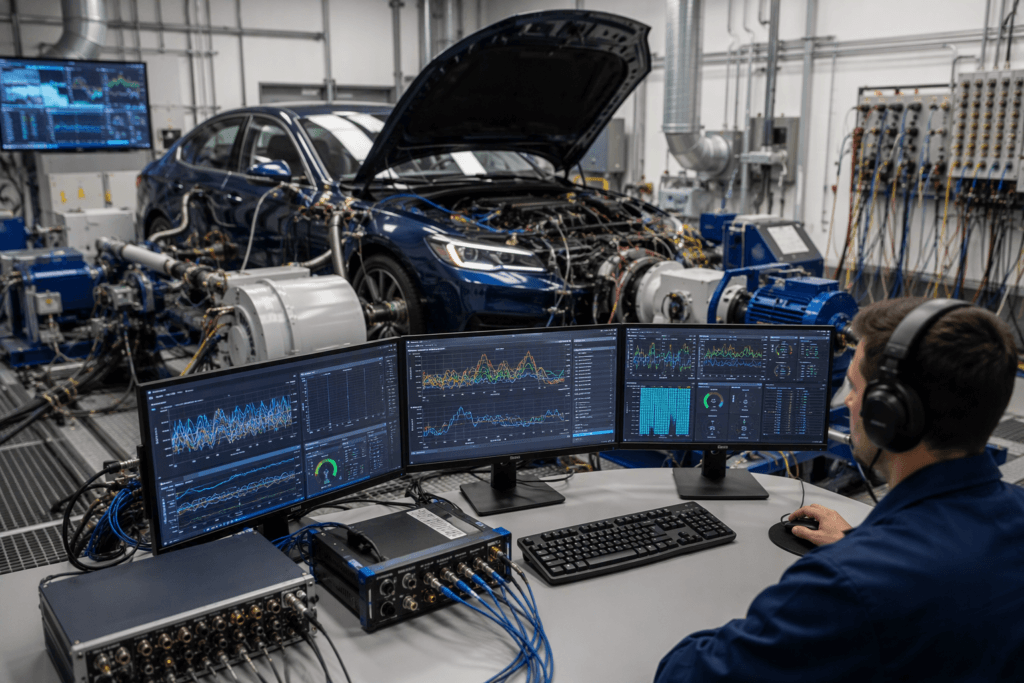
In modern mobility R&D, the ability to capture, process, and analyze data accurately is often the difference between a successful development program and costly delays. Whether testing an internal combustion engine, electric powertrain, battery pack, fuel cell, or hybrid system, engineers rely on high-speed real-time data acquisition (DAQ) systems to understand exactly what is happening during testing.
Systems such as A&D Technology’s Phoenix DAQ platform, which is also widely used as a Combustion Analysis System (CAS), provide the speed, precision, synchronization, and analysis capabilities required for today’s demanding test environments.
What Is Data Acquisition (DAQ)?
Data acquisition is the process of collecting information from sensors, instruments, controllers, and test equipment and converting that information into digital data that engineers can monitor, store, and analyze.
A typical DAQ system performs four primary functions:
- Measures physical phenomena using sensors
- Converts analog signals into digital values
- Processes and timestamps the data
- Stores and displays the information for analysis
Think of a DAQ system as the central nervous system of a test cell. It continuously gathers information from dozens, hundreds, or even thousands of channels and turns raw measurements into actionable engineering insights.
What Does “Real-Time” Mean?
In engineering test environments, real-time means the system collects, processes, and responds to incoming data with deterministic timing and minimal latency.
Rather than recording data and analyzing it later, a real-time DAQ system can:
- Display measurements instantly
- Trigger events when conditions are met
- Adjust control systems automatically
- Synchronize test equipment in real time
- Protect valuable hardware through safety interlocks
For example, during an engine durability test, engineers may need to monitor oil pressure, cylinder pressure, exhaust temperatures, and fuel flow continuously. If a critical parameter exceeds a limit, the real-time system can immediately trigger alarms or shut down the test stand before damage occurs.
This capability is especially important for combustion analysis, emissions development, hybrid vehicle testing, battery validation, and hardware-in-the-loop (HIL) simulations.
What Is Considered High-Speed Data Acquisition?
The definition of “high speed” depends on the application.
Low-Speed Measurements
Typically:
- 1 Hz to 100 Hz
Examples:
- Coolant temperature
- Ambient conditions
- Fuel consumption averages
Medium-Speed Measurements
Typically:
- 100 Hz to 10 kHz
Examples:
- Vibration monitoring
- Motor torque
- Dynamometer measurements
- Actuator position data
High-Speed Measurements
Typically:
- 10 kHz to several MHz
Examples:
- Cylinder pressure
- Injector current
- Ignition signals
- Combustion events
- Knock detection
- High-frequency vibration analysis
A&D’s Phoenix platform supports the synchronized acquisition of both high-speed and low-speed channels, ensuring engineers can analyze dynamic events alongside traditional test measurements within a single dataset.
What Types of Data Can Be Collected?
Modern DAQ systems are designed to connect with virtually any sensor or instrument used in a test environment.
Common measurements include:
Mechanical Data
- Torque
- Speed (RPM)
- Force
- Pressure
- Displacement
- Strain
Thermal Data
- Thermocouples
- RTDs
- Coolant temperatures
- Exhaust temperatures
Electrical Data
- Voltage
- Current
- Power
- Frequency
- Battery measurements
Vehicle and Powertrain Data
- CAN bus data
- CAN FD signals
- Ethernet communications
- ECU parameters
- Diagnostic information
Combustion Data
- Cylinder pressure
- Crank angle position
- Heat release calculations
- Knock intensity
- Peak firing pressure
- Mass fraction burned
Environmental Data
- Humidity
- Atmospheric pressure
- Airflow
- Emissions concentrations
The ability to collect all these measurements simultaneously allows engineers to correlate system behaviors and understand cause-and-effect relationships across the entire test article.
Phoenix as a Combustion Analysis System (CAS)
One of the most powerful applications of the Phoenix platform is combustion analysis.
In combustion development testing, high-speed pressure transducers installed in each cylinder measure combustion events at extremely high resolution. The system synchronizes these measurements with crank-angle encoder data to capture combustion performance cycle-by-cycle.
Engineers can analyze:
- Indicated Mean Effective Pressure (IMEP)
- Peak cylinder pressure
- Combustion phasing (CA10, CA50, CA90)
- Heat release rates
- Knock detection
- Combustion stability
- Air-fuel mixture effects
These insights help development teams improve:
- Fuel economy
- Emissions performance
- Engine durability
- Calibration strategies
- Alternative fuel compatibility
What Files Does a DAQ System Create?
A high-speed DAQ system typically generates several file types depending on the application and software environment.
Common outputs include:
Raw Data Files
Contain:
- Time-series measurements
- Sensor values
- Channel metadata
- Calibration information
These files preserve the original test data for future analysis.
High-Speed Binary Files
Used when recording large amounts of data efficiently.
Benefits:
- Smaller storage footprint
- Faster recording rates
- Reduced system overhead
Processed Data Files
Contain:
- Averaged data
- Calculated channels
- Statistical summaries
- Event markers
Export Files
Often saved as:
- CSV
- Excel
- MDF/MF4
- ASCII
- MATLAB-compatible formats
These formats allow data sharing across engineering teams and analysis tools.
How Are DAQ Files Used for Analysis?
Once testing is complete, engineers use analysis software to convert raw measurements into engineering knowledge.
Typical analysis activities include:
Trend Analysis
Reviewing performance over:
- Hours
- Days
- Months
- Entire durability programs
Event Analysis
Investigating:
- Failures
- Anomalies
- Transient behaviors
- Calibration issues
Statistical Analysis
Calculating:
- Averages
- Standard deviations
- Peak values
- Distributions
Correlation Studies
Determining relationships between:
- Engine load and combustion stability
- Battery temperature and performance
- Fuel changes and emissions output
Visualization
Generating:
- Time histories
- Scatter plots
- Heat maps
- Frequency spectra
- Combustion pressure traces
Data management and analysis platforms help engineers organize, search, visualize, and compare large volumes of test data across programs and facilities.
What Happens After the Data Is Analyzed?
Data itself has little value until it drives decisions.
Engineering teams use DAQ-generated insights to:
Improve Designs
Identify weaknesses and optimize component performance.
Validate Requirements
Confirm products meet performance targets and regulatory standards.
Calibrate Controllers
Refine ECU, inverter, and battery management system strategies.
Predict Failures
Detect trends before hardware damage occurs.
Accelerate Development
Reduce test iterations and shorten development cycles.
Support Digital Engineering
Feed simulation models, digital twins, and machine-learning workflows.
In many organizations, data collected during testing becomes a permanent engineering asset that supports future product development programs.
Why High-Speed Real-Time DAQ Matters
As engines, electric powertrains, batteries, and hybrid systems become increasingly complex, engineers need more than simple data logging. They need synchronized, deterministic, high-speed measurement platforms capable of capturing both slow-changing system behavior and microsecond-level events.
A&D Technology’s Phoenix platform delivers the high-speed acquisition, real-time monitoring, and advanced combustion analysis capabilities required by today’s OEMs, Tier 1 suppliers, research institutions, and independent test laboratories. Whether supporting traditional engine development, advanced combustion research, battery testing, or next-generation mobility technologies, Phoenix helps engineers transform data into actionable engineering decisions.